


The publication of Alan Milburn's review into young people and work has put the spotlight on the growing number of young people not in education, employment or training (NEET). Tackling this challenge means looking deeper than just the transition into adulthood, however. The review makes a powerful case for earlier intervention in schools and specifically recognises nurtureuk and the Boxall Profile® as part of the solution. So what does the report mean for schools, and what needs to happen next?
Published on 17 November 2026, From a Welfare State to a Working State: A New Settlement for the Next Generation examines the reasons behind rising levels of young people not in education, employment or training, and what needs to change. With almost one million young people aged 16–24 currently NEET, the review calls for a fundamental shift in how we re-engage young people.
While much of the debate has focused on youth unemployment and welfare reform, there is an important message for education: the risk of disengagement in adolescence cannot be tackled effectively without understanding and responding to children's needs much earlier.
What does the Milburn Review say about education?
The review argues that schools must do more than equip pupils with academic knowledge and qualifications. They also have a vital role in developing the skills, confidence and capabilities young people need to navigate adult life.
Its recommendations include:
- Improving school readiness: raising the ambition for at least 90% of children to reach a good level of development by the end of Reception by 2036.
- Identifying needs earlier: introducing low-stakes checks at Key Stage 3 to help schools identify learning gaps and intervene sooner.
- Strengthening support for vulnerable pupils: ensuring that young people at risk of disengagement are identified and supported before difficulties become entrenched.
- Preparing young people for adult life: placing greater emphasis on the wider skills, experiences and opportunities needed to progress into further education, training and employment.
The underlying message is clear: prevention matters. We need to identify barriers earlier and ensure that young people do not lose their connection with education before they reach adulthood.
Recognition of nurture and early intervention
One of the most important sections for schools appears in chapter four, Identifying and acting on risk.
The report states that: "Schools need to become stronger protective institutions." It recognises that for pupils who struggle with attention, relationships, behaviour or emotional regulation, having a consistent, trusted adult and the right support can make the difference between remaining engaged in education and gradually disengaging from it.
It goes further, stating that: "A stronger nurture offer within schools should be part of early intervention, helping identify social and emotional needs before they become entrenched."
Significantly, the report explicitly names nurtureuk and the Boxall Profile®, recognising their role in helping schools identify children's needs and target support through assessment tools and evidence-based interventions.
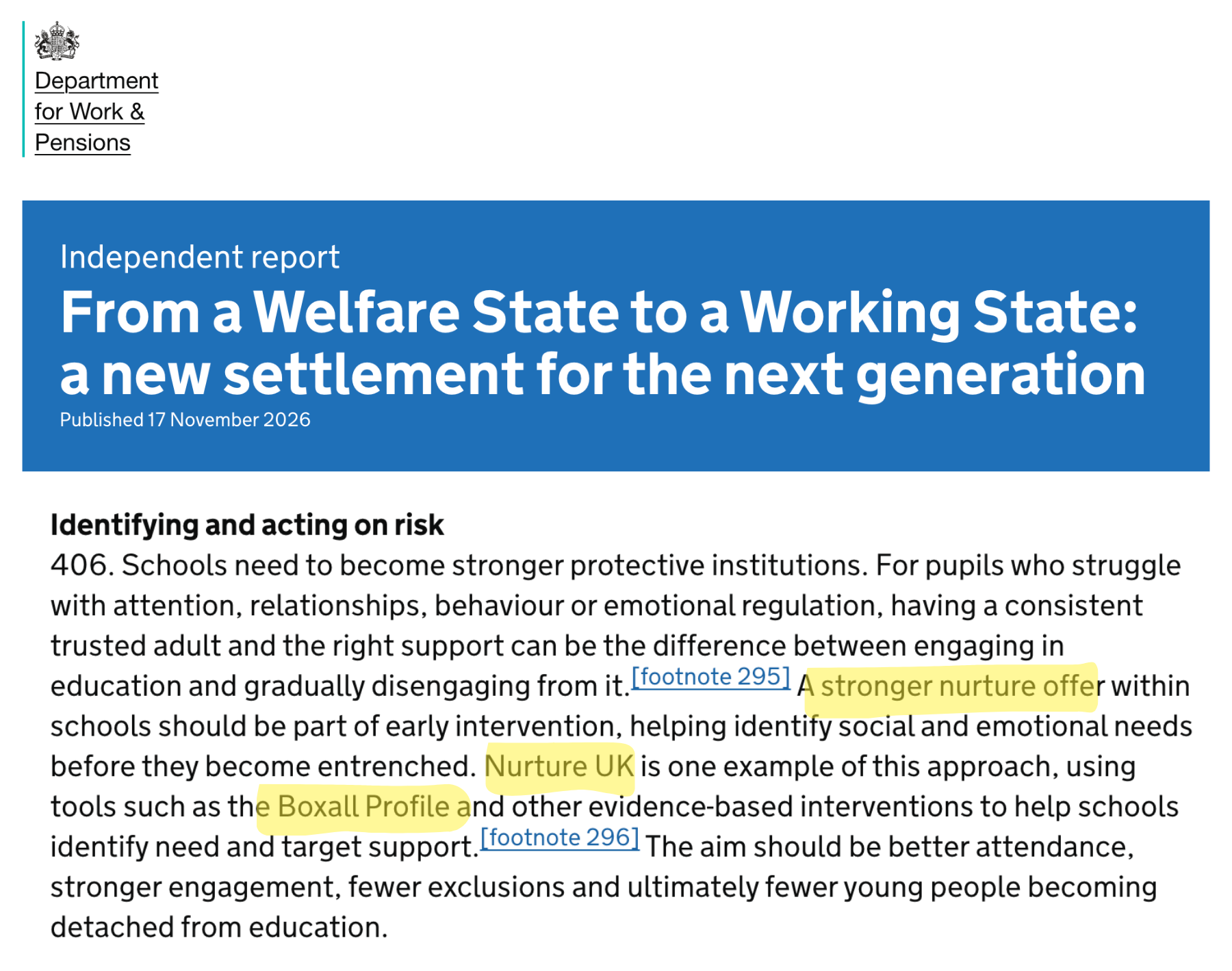
Milburn connects the nurture approach with better attendance, stronger engagement, fewer exclusions and ultimately fewer young people becoming detached from education. This is important recognition of the work nurtureuk has championed for more than 50 years. It reinforces our fundamental belief: children's social and emotional development is central to their ability to engage, learn and fulfil their potential.
What does this mean for schools in practice?
The review has important implications for how schools approach inclusion, behaviour, attendance and early intervention. In particular, it highlights four priorities.
- Building relationships that prevent disengagement: ensuring pupils at risk have a consistent, trusted adult who understands their circumstances and can recognise when they are beginning to struggle.
- Looking beyond behaviour: understanding the reasons behind persistent absence, challenging behaviour and exclusion, rather than simply responding to what is visible.
- Identifying needs early: recognising when difficulties with social and emotional development are affecting a child's ability to learn, and putting appropriate support in place before problems escalate.
- Developing staff expertise: equipping teachers and other education professionals with the knowledge and confidence to recognise developmental needs and respond effectively.
These are not challenges schools can address through policy statements alone. They require the right tools, training and a whole-school commitment to understanding and supporting children's needs.
How can nurtureuk help schools respond?
A nurturing approach offers a practical, evidence-informed way to put these principles outlined in the review into practice. At its heart is the understanding that positive, consistent relationships provide the foundations for children's social and emotional development and their ability to engage with learning.
Through its work with schools and education professionals, nurtureuk supports this in three complementary ways:
- Understanding need: The Boxall Profile® helps practitioners assess children's social and emotional development, identify unmet needs and plan targeted support. It also enables schools to monitor progress and evaluate the impact of interventions.
- Putting support in place: Nurture groups and other evidence-based interventions provide children experiencing difficulties with opportunities to develop the skills they need to engage successfully with learning.
- Building lasting change: Whole-school nurturing approaches, supported by professional development and training, help embed relational practice and a shared understanding of children's needs across the school community.
Together, these approaches help schools move beyond identifying that a child is struggling, to understanding what they need and how best to support them.
If we are serious about tackling the NEET crisis and improving young people's life chances, we must start by getting the foundations right. Every child deserves to be understood, supported and given the opportunity to develop the skills they need to engage, learn and thrive.