
In today’s schools, the challenge is no longer solely about raising attainment, it is about removing the barriers to learning that pupils experience in the first place. Increasingly, these barriers are social, emotional, and developmental rather than purely academic. For school leaders preparing for Ofsted inspections, the message is clear:
Outcomes improve when schools create environments where pupils feel safe, understood, and ready to learn.
Nurture group practice, when positioned strategically, offers not just targeted support, but a measurable and sustainable route to whole-school improvement.

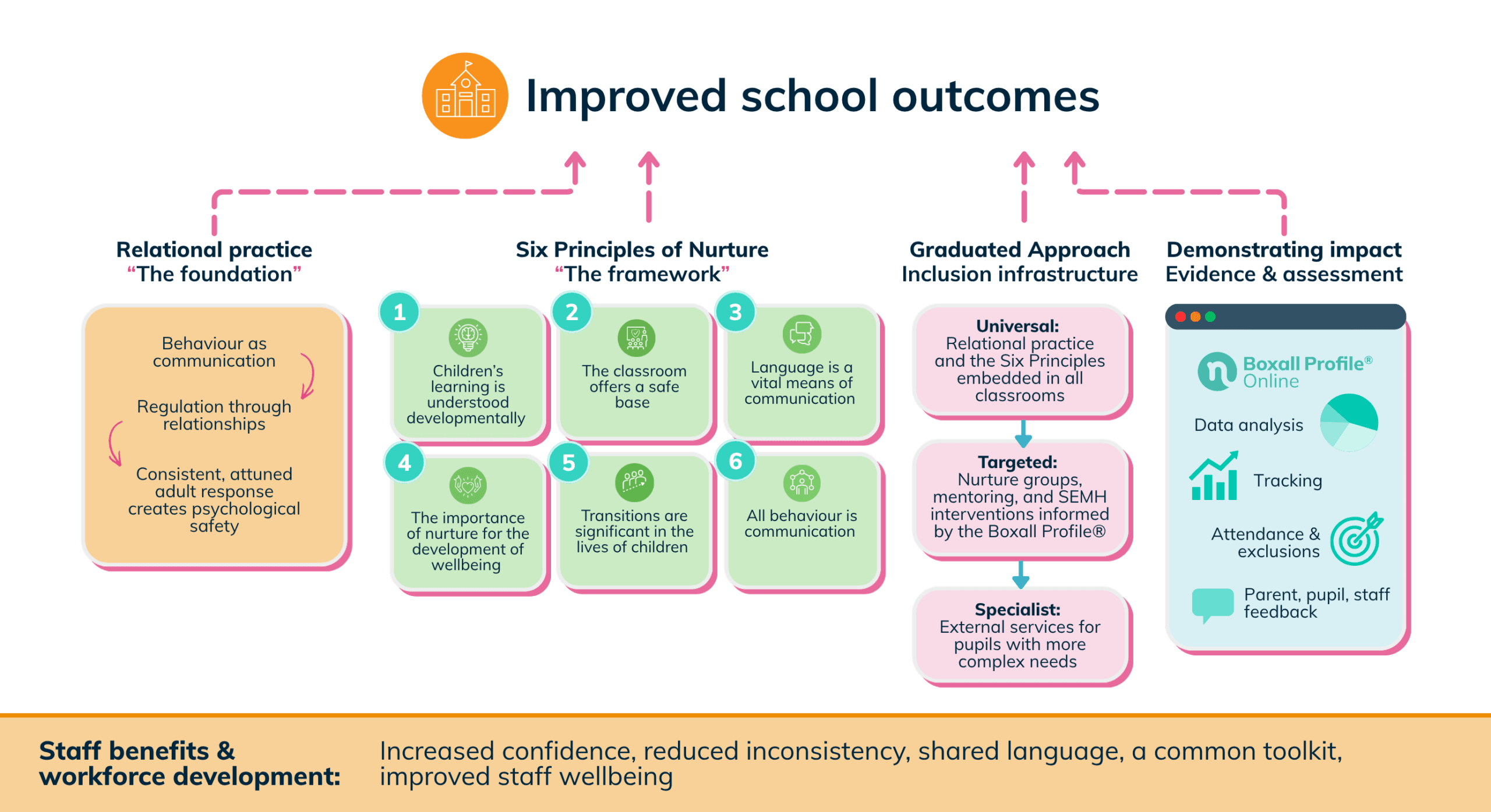
The foundation: Relational practice
At the heart of effective nurture lies relational practice. This is not an add-on strategy, but the foundation of how adults interact with pupils across the school. Relational practice is built on the understanding that:
- Behaviour is a form of communication
- Regulation is developed through relationships
- Consistent, attuned adult responses create psychological safety
In practice, this means:
- Predictable routines and clear structures
- Calm, regulated adult behaviour
- Co-regulation before expectations of self-regulation
- Repair and restoration following difficulty
When embedded, relational practice shifts the culture from reactive behaviour management to proactive, relationship-driven support.
The framework: Six Principles of Nurture
Relational practice is operationalised through the Six Principles of Nurture, which provide a clear, evidence-informed framework for both targeted provision and whole-school culture:
- Children’s learning is understood developmentally
- The classroom offers a safe base
- The importance of nurture for the development of wellbeing
- Language is a vital means of communication
- All behaviour is communication
- Transitions are significant in the lives of children
These principles can guide decision-making at every level from classroom practice to leadership strategy ensuring consistency, coherence, and clarity of approach.
Join our next cohort of nurture group training and become a qualified nurture practitioner
From intervention to strategic infrastructure
Nurture groups are often viewed as a targeted provision for a small number of pupils. However, effective schools position nurture as part of their core inclusion infrastructure. Nurture is not about fixing pupils; it is about addressing the conditions that make learning possible. When pupils are dysregulated, anxious, or disconnected, traditional strategies often fail to secure engagement. Nurture addresses this at the source.
Importantly, it also provides a model of practice that can be scaled, shifting adult responses across the school from reactive to relational.
A graduated and strategic approach
Nurture can be most effective when embedded within a clear graduated response:
- Universal: Relational practice and the Six Principles embedded in all classrooms
- Targeted: Nurture groups, mentoring, and SEMH interventions informed by the Boxall Profile®
- Specialist: External services for pupils with more complex needs
This ensures early identification, appropriate intervention, and reduced escalation supporting both inclusion and resource efficiency.
The Boxall Profile®: Assessment, precision, and impact
The Boxall Profile® is central to high-quality nurture practice. It provides a robust, evidence-based tool for understanding pupils’ social and emotional development.
It enables schools to:
- Identify individual strengths and areas of need
- Inform targeted, personalised intervention planning
- Track progress over time with measurable outcomes
- Analyse trends at group, class, and whole-school level
This moves nurture beyond intuition, allowing leaders to demonstrate precision, accountability, and impact – key requirements for Ofsted inspections.
High-quality nurture
Effective nurture provision is intentional, structured, and evidence-informed. It typically includes:
- Small, time-limited group interventions (e.g. nurture groups, inclusion bases)
- Consistent, highly attuned adults
- A predictable, safe environment
- Integration of academic, social, and emotional learning
Underpinning this is a developmental understanding of behaviour, supported by explicit teaching of communication and emotional literacy. The Boxall Profile® ensures that this provision is sharply focused and responsive to need.
Whole-school nurture
The real power of nurture lies in its ability to scale into whole-school practice. This means:
- Policies rooted in relational principles, not just compliance
- Staff trained in attachment-aware and trauma-informed approaches
- Consistent adult responses across all contexts
- Classrooms functioning as safe, structured environments
Nurture groups act as both targeted support and a model of excellence, with practice extending into all classrooms through shared language and expectations.

Nurture and Ofsted
Nurture actively enables success across the Ofsted inspection framework:
- Quality of Education: Pupils develop the foundational capacities (e.g. attention, self-regulation, social understanding) required for learning
- Behaviour & Attitudes: Behaviour improves as needs are understood and addressed
- Personal Development: Emotional literacy, resilience, and relationships are explicitly developed
- Leadership & Management: Leaders demonstrate a coherent, evidence-informed approach to inclusion and early intervention
The Boxall Profile® strengthens this further by providing clear, trackable evidence of impact over time.
Impact of nurture
To position nurture as a strategic asset, its impact has to be visible and measurable. Schools can track:
- Boxall Profile® progress (entry, review, exit data)
- Attendance and persistent absence
- Behaviour incidents, suspensions, and exclusions
- Reintegration success and time in class
This is strengthened by qualitative evidence through pupil voice, parent feedback, staff confidence and consistency. Together, this provides a compelling narrative of impact, improvement, and sustainability. In a climate of constrained budgets, nurture represents a preventative investment:
- Reducing reliance on exclusions and alternative provision
- Supporting pupils to remain in mainstream education
- Minimising demand on external services
Over time, this leads to both improved outcomes and financial sustainability.
Join our next cohort of nurture group training and become a qualified nurture practitioner
Nurture in secondary: Adapting without diluting
Nurture principles are equally relevant in secondary settings, though delivery differs. Effective models include:
- Flexible, part-time interventions
- Strong mentoring relationships
- Integration with mainstream timetables
- Focus on identity, resilience, and future pathways
Transitions are particularly critical at this stage. Maintaining dignity and autonomy is essential for engagement.
Workforce development
Nurture is also a powerful driver of staff development. Through training in relational practice and the Six Principles, schools can:
- Increase staff confidence in responding to behaviour
- Reduce inconsistency across classrooms
- Improve staff wellbeing by reducing conflict
The Boxall Profile® further supports this by giving staff a shared, objective language to understand and respond to need.
A cultural shift that changes outcomes
Nurture challenges a long-standing assumption that pupils must demonstrate good behaviour before they are ready to learn. Instead, it recognises:
Behaviour improves when pupils feel safe, regulated, and connected.
Grounded in the foundation of relational practice, guided by the framework of the Six Principles of Nurture, and evidenced through the Boxall Profile®, this becomes not just a philosophy but a practical, system-wide approach to improvement.
Nurture group practice is not simply about supporting vulnerable pupils, it is about strengthening the system that supports all pupils. For school leaders, it provides a strategic opportunity to:
- Remove barriers to learning at their root
- Deliver on inclusion and equity
- Improve outcomes across all Ofsted judgement areas
- Build a consistent, relational school culture
When implemented with clarity and leadership, nurture can move beyond intervention and become a cornerstone of sustained school improvement.