

In an increasingly complex educational landscape, schools are required to meet not only academic targets but also the growing social, emotional, and mental health needs of their students. For many children and young people – particularly those affected by adverse childhood experiences, unmet attachment needs, or chronic stress – the classroom can feel overwhelming rather than supportive.
Nurture group practice offers a powerful, evidence-informed response that places relationships, emotional safety, and developmental understanding at the heart of learning. This blog provides insight into planning and structuring your nurture group to see the most positive impact on pupil outcomes.
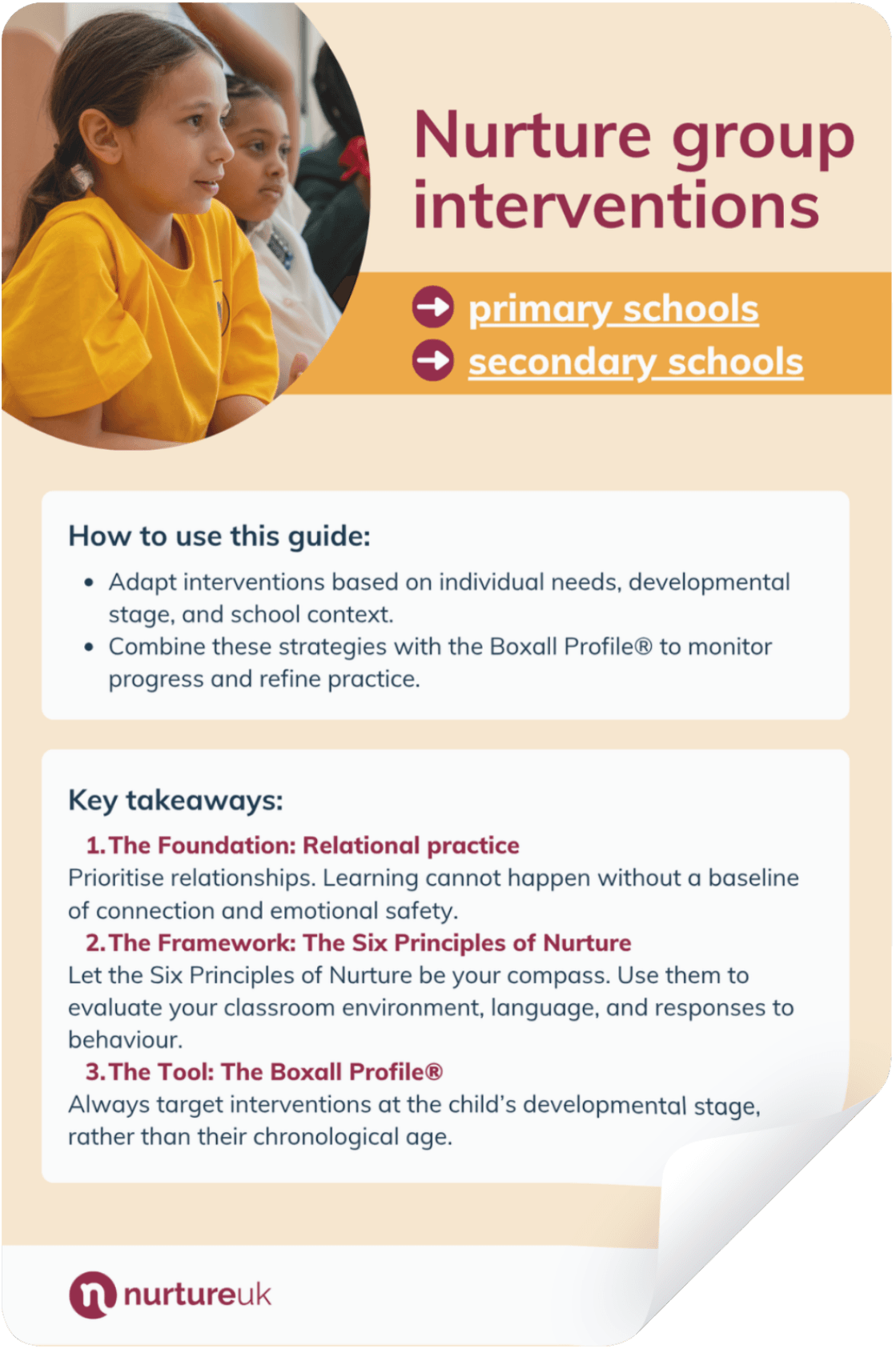
Download our free guide to nurture group interventions
With primary and secondary school examples.
Submit the form below to claim your free guide on belonging
A relational approach to unlocking potential
What is a nurture group?
A nurture group is a targeted, short- to medium-term intervention designed to support pupils who are unable to fully access learning due to social, emotional, or behavioural needs. Grounded in attachment theory and informed by developments in neuroscience, nurture groups provide a structured, predictable environment in which pupils experience consistency, connection, and care.
Groups are typically small (6–12 pupils), staffed by trained adults, and offer a balance of academic, social, and emotional learning opportunities.
The Boxall Profile®
Effective nurture practice combines qualitative insight with structured assessment. The tool in this process is the Boxall Profile®, a standardised assessment framework used to evaluate children and young people’s social, emotional, and behavioural development.
It enables practitioners to:
- Identify strengths and needs
- Inform targeted intervention planning
- Monitor progress over time
Importantly, the Boxall Profile® reinforces a developmental, relational understanding of behaviour, aligning closely with nurture principles and supporting evidence-informed practice.
Relational practice
Children do not arrive at school as uniformly ready learners. Their readiness is shaped by early relationships, lived experiences, and their capacity for emotional regulation. Where these foundations are disrupted, behaviour is more accurately understood as communication rather than defiance.
Nurture practice is underpinned by three key assumptions:
- Connection precedes cognition
- Emotional regulation underpins engagement
- Relationships are the primary mechanism for change
This perspective supports a shift away from punitive behaviour models towards relational, trauma-informed approaches.
The Six Principles of Nurture underpin all nurture work:
- Children’s learning is understood developmentally
- The classroom offers a safe base
- The importance of nurture for the development of wellbeing
- Language is a vital means of communication
- All behaviour is communication
- The importance of transitions in children’s lives

Try our Snack Time for Nurture Groups bundle!
Nurture practice in primary settings
Key elements of primary school nurture practice can include:
- A safe environment
- Routine and structure
- Developmentally responsive teaching
- Adult attunement and co-regulation
- Social skills and emotional learning activities
Find specific examples in our free guide to nurture group interventions below.
Nurture practice in secondary settings
Adapting nurture for adolescents requires sensitivity to age, autonomy, and identity. Key features can include:
- Preserving dignity and autonomy
- Flexible and integrated models
- Focus on identity and life skills
- Relational consistency
- Practical skill-building
Find specific examples in our free guide to nurture group interventions below.
Download our free guide to nurture group interventions
With primary and secondary school examples.
Submit the form below to claim your free guide on belonging
Are you ready to start your nurture group?
Nurture group practice flips the traditional script: rather than viewing controlled behavior as a prerequisite for learning, we recognise it as the result of feeling safe and understood.
By moving beyond 'intervention' and toward a deep commitment to Relational Practice, guided by the Six Principles of Nurture and the Boxall Profile® we can create an environment where connection leads, potential can be unlocked and meaningful learning can follow.