

In education, we rightly champion the importance of belonging for children and young people. We recognise that when pupils feel accepted, valued, and connected, they are far more likely to engage, learn, and flourish. However, belonging is not a need that we outgrow. It is just as fundamental for the adults who lead, support, and manage our educational settings.
A strong sense of staff belonging is not a "nice-to-have" luxury; it is the bedrock of wellbeing, retention, collaboration, and collective efficacy. When educators feel they belong, they are empowered to innovate, take pedagogical risks, support their peers, and commit deeply to the success of the school’s vision.
Furthermore, under Ofsted’s updated inspection framework, school culture and wellbeing are no longer evaluated purely through top-down policies. Inspectors now scrutinise the operational reality of inclusion and staff workload. They evaluate whether the positive environment described by leaders matches the daily experience of the workforce.
By applying The Six Principles of Nurture to our education settings, we can build a culture that allows everyone to thrive.
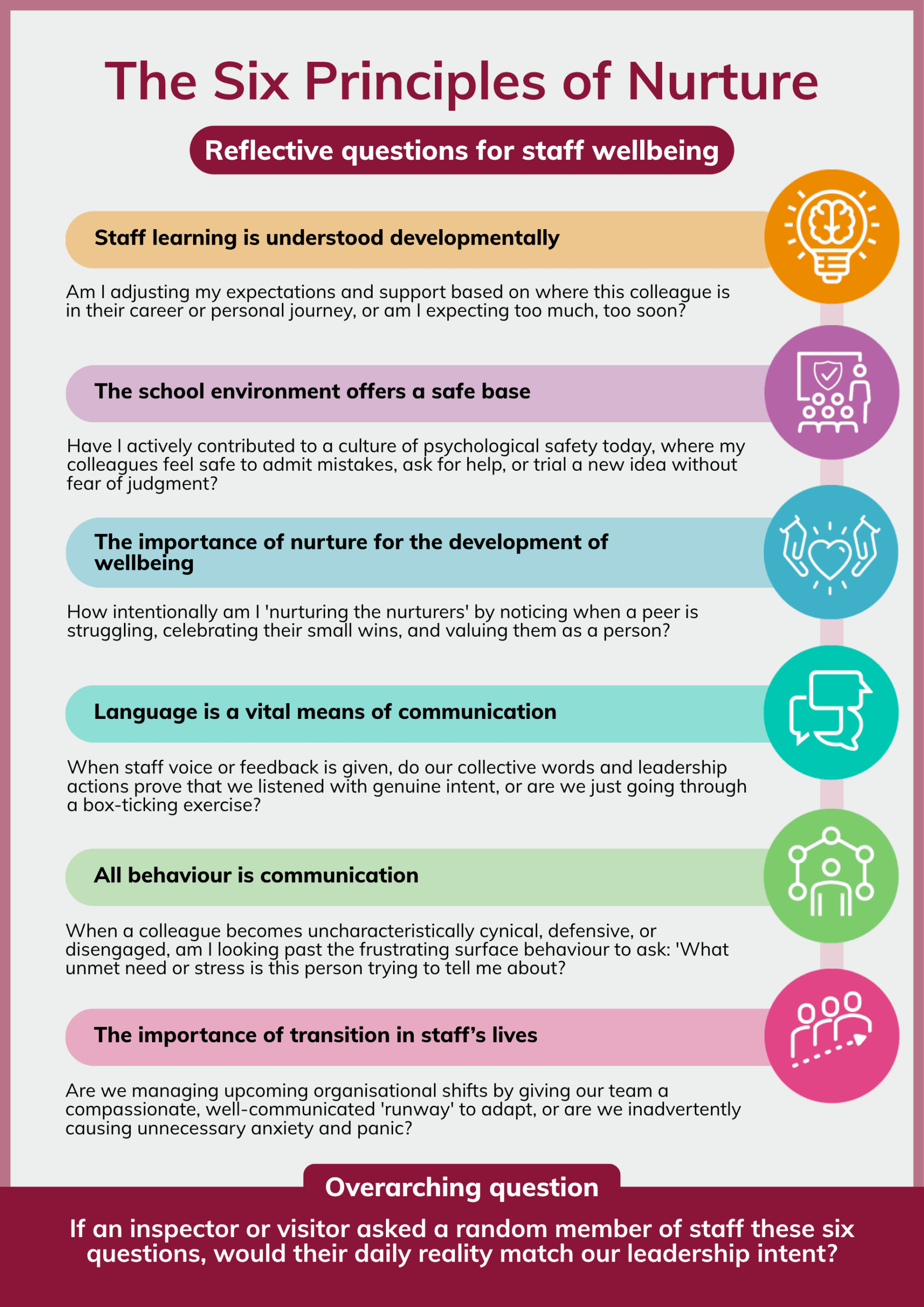
The Six Principles of Nurture: Reflective questions for staff wellbeing
Try out these questions to provoke reflection on staff belonging. Click below to download, share with your team, and maybe even print off and display in your staff room?
Defining belonging for school staff in the workplace
Belonging is the feeling of being accepted for who you are, respected for what you contribute, and genuinely connected to those around you. It is the psychological safety of knowing your voice matters and that you occupy a meaningful space within the team.
In education, this culture is not achieved by one single thing – a staff training, a tokenistic initiative, or a hurried preparation for an inspection window. It is built through everyday interactions, shared experiences, and intentional leadership. It requires trust, consistency, and a deliberate effort to align our adult working environment with nurture-based practices.
Aligning staff wellbeing with the Six Principles of Nurture
To cultivate a workplace where staff genuinely thrive, we can map our actions directly to The Six Principles of Nurture, grounded in actionable school examples and Ofsted expectations.
1. Children’s [staff's] learning is understood developmentally
The principle: Learning happens at different paces, and individuals require different levels of support depending on their experience and current capacity.
In an adult context, this means recognising that staff are at different stages of their careers and personal journeys. A warm, thorough induction process is vital for new starters. Similarly, when staff take on new roles or face professional hurdles, they need scaffolded support.
2. The classroom [school environment] offers a safe base
The principle: A predictable, secure, and physically/psychologically safe environment is essential for growth and exploration.
Leaders create a "safe base" by being visible, approachable, and consistent. When staff know that mistakes are treated as learning opportunities rather than failures, they feel safe to innovate.
3. The importance of nurture for the development of wellbeing
The principle: Nurture involves listening, responding with empathy, and actively valuing the individual.
We must actively nurture our nurturers. This means celebrating successes, noticing when a colleague is struggling, and recognising both professional milestones and personal life events. Small gestures such as a thank-you note, a quiet word of appreciation, or structured peer-mentoring can signal to staff that they are valued as human beings.
4. Language is a vital means of communication
The principle: The words we use and how we listen shape our relationships and self-worth.
Belonging grows when people feel genuinely heard, incorporating listening with intent, encouraging authentic staff voice, and acting upon feedback.
5. All behaviour is communication
The principle: Challenging or unusual behaviour is often an expression of an underlying, unmet need.
Nurturing leadership looks beyond the surface behaviour, responding with empathy, curiosity, and support rather than immediate frustration or discipline. Just like pupils, staff experience bad days and complex home lives which may have an impact on how they show up at school.
6. The importance of transition in children's [staff] lives
The principle: Change can be destabilising and requires careful management and emotional preparation.
Educational settings are hotbeds of transition whether it is a change in the curriculum, a shift in leadership, or a colleague returning from parental or sick leave. Managing these transitions thoughtfully by providing clear communication, emotional reassurance, and practical time to adapt reduces stress.
Leadership’s role: Modelling the culture

While fostering a sense of belonging is a collective responsibility, when leadership prioritises nurturing principles, they send an unmistakable message: the people in this building matter.
As educational professionals, we relentlessly reflect on how to optimise outcomes for our learners. To do that effectively, we must regularly turn that reflective lens inward:
- Do all staff members truly feel welcomed, safe, and valued from day one?
- Are we actively listening to the hidden communication behind staff stress or disengagement?
- How intentionally do we manage professional and personal transitions for our team?
- What small, daily action can we take today to strengthen the connections across our school?
By intentionally nurturing our staff, we create an environment where the adults can thrive and when staff thrive, the children and young people can reap the rewards.
Next steps
Transform your whole-school culture for staff, pupils, and families with the National Nurturing Schools Programme. At the end of this 18-month structured programme you'll become a recognised nurturing school with an inclusive school culture you can demonstrate to Ofsted inspectors.
“Staff are nurtured too; we all nurture each other.”
Staff member at a National Nurturing School